Part 3 of 3 from Big Mike Fund Podcast Episode 314 with Dr. Param Baladandapani.
▶️ Watch the full episode on YouTube
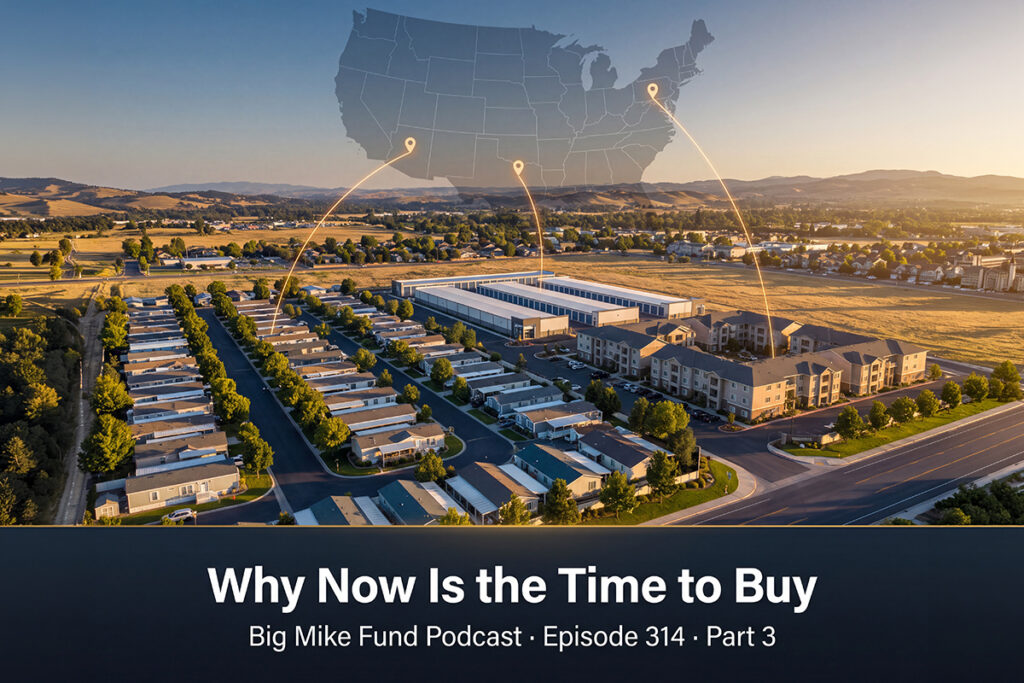
In Parts 1 and 2, Dr. Param Baladandapani shared how she reached financial freedom and how investors can find their place on the risk spectrum. In this final part, recorded in summer 2026, she explains why she believes this is one of the best times in years to buy real estate, and why creative value-add has replaced the old playbook.
Mike Zlotnik asked the question many listeners have: if you’re near retirement, have done well in the stock market and want to diversify into steady passive income with downside protection, what should you look at today?
“Our 2009–2010 equivalent”
Param’s answer was direct: “This is a great time to be opportunistic, because we’re at the bottom of the market cycle.” The prices at which assets can be bought today are far more attractive than in recent years. Despite economic uncertainty, she compared this moment to 2009 and 2010, when patient investors acquired great assets at great prices.
The basics still apply. Do your due diligence, keep emotions out of it, and buy quality assets in markets with strong fundamentals that you’d be willing to hold for the long term. Pay close attention to new supply, which is hurting some submarkets more than others.
Plan for rates that stay high
Param’s second point was about debt. Many investors had assumed interest rates would come down. She now plans for an environment where inflation trends upward and rates stay elevated.
That means being deliberate about the type of debt, your position in the capital stack and the debt service coverage ratio (DSCR), which measures how comfortably a property’s income covers its loan payments. Her team targets multifamily, manufactured housing and self-storage assets that produce 5% to 7% cash flow from day one. “There’s safety in that,” she said. “That itself is a buffer.”
Mike agreed. He looks for a healthy positive spread between a property’s cap rate and its interest rate, ideally with fixed-rate debt. That spread creates a margin of safety. If inflation can’t be brought under control, he noted, elevated rates may become the norm, and fixed-rate debt with conservative coverage becomes essential.
Creative value-add: the new playbook
For years, the standard value-add plan was to buy a property, spend heavily on renovations and raise rents. Param says that isn’t the right approach in this cycle. Her team has shifted to creative value-add, which focuses on levers the owner controls even in an uncertain economy:
- Cut operating expenses on day one. Take over properties from operators who haven’t run them well, and streamline operations. Param calls this one of the fastest ways to add value right now.
- Pursue property tax exemptions. Where available, these can raise net operating income significantly from the start.
- Assume existing loans. Some properties still come with assumable debt at favorable terms and a longer runway.
This approach works even in Sunbelt markets like Texas and Georgia, where cash flow has been hard to find, without counting on rent growth.
Mike shared another example of value-add without heavy renovation. His team is working on a medical office portfolio in Texas, where triple-net leases with built-in rent escalations of about 2.5% to 3% grow income automatically. Multifamily rents depend on supply and demand, and the Sunbelt still has a lot of new supply.
Both agreed the demand fundamentals for housing remain strong. Param pointed to a national shortage of four to five million housing units. With today’s home prices and interest rates, renting is more affordable than buying for many households.
Diversify across assets, places and time
Param’s team has also moved toward longer-term funds diversified across asset classes and geography. Its current fund focuses on manufactured housing, with assets in more than 30 states.
She described three kinds of diversification:
- Across asset classes, as long as each is recession resilient
- Across geography, so no single market can sink the portfolio
- Across time, by continuing to invest through different points in the market cycle
Mike pointed to Ray Dalio’s principle of holding many uncorrelated return streams. He also noted that Dalio has recently warned about the risk of an AI-driven stock market bubble, one more reason to take some chips off the table and diversify. Mike calls the third type “diversification in time,” the real estate cousin of dollar-cost averaging.
Param believes most investors should hold at least 25% of their portfolio in alternative assets, including real estate. Mike said that when he asked several AI tools the same question, they suggested 25% to 40%, counting a primary residence.
Lessons from the 2022 peak
Param was candid that her team learned from experience. Many commercial real estate investors bought in 2021 through 2023, near the market peak, and have spent the past two years working through the consequences. “A lot of this comes from pain,” she said. Streamlining operations became the only way to make some of those deals work, and that experience shaped today’s strategy.
Mike called that honesty a sign of strength. Quoting John Maxwell: sometimes you win, sometimes you learn. In his view, the investors who acknowledge the lessons of 2022 and keep going will separate themselves from those who don’t.
“You have to start before you’re ready,” Param said.
Connect with Dr. Param Baladandapani
- Free passive investing guide: gwcapital.com/guide
- GW Capital: gwcapital.com
- Generational Wealth MD, with a free ebook on active strategies and tax savings: generationalwealthmd.com
Read the full series: Part 1: From $2,000 to $10,000 a Month [Read Now] · Part 2: Know Your Buy Box [Read Now]
▶️ Watch the full episode on YouTube
Disclaimer: This content is for educational purposes only and is not tax, legal or investment advice. Opinions of guests are their own. Consult a licensed CPA before making any financial or tax decisions. See our full Disclaimer.