Part 1 of 3 from Big Mike Fund Podcast Episode 309 with Chase Macleod
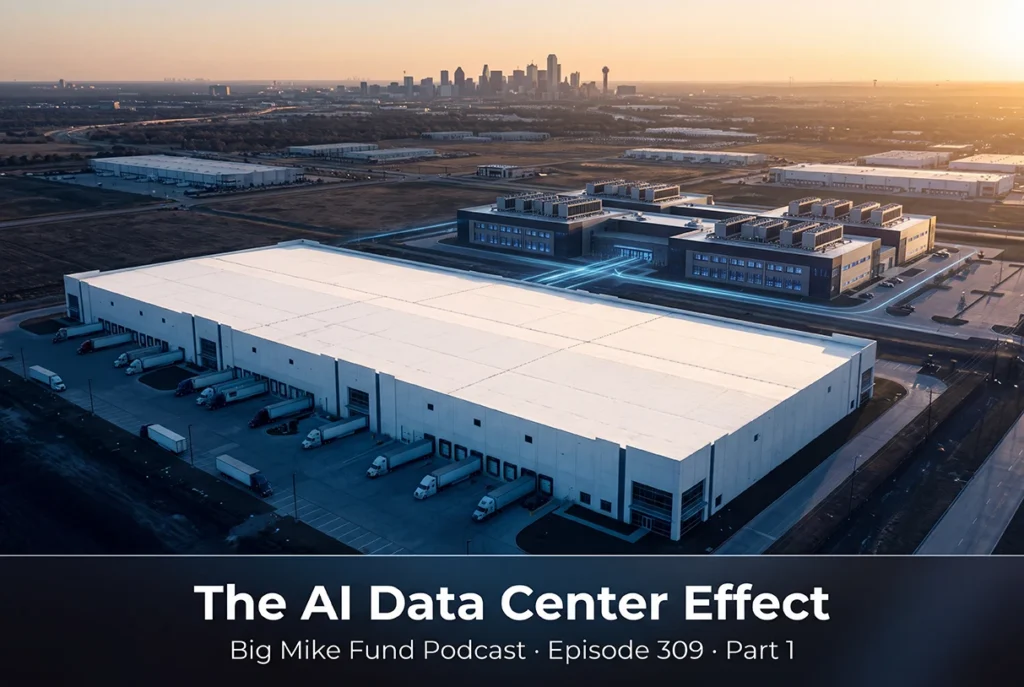
If you’ve been reading the headlines, you’ve probably heard that Dallas-Fort Worth (DFW) industrial real estate is overbuilt. Drive the highways and you’ll see plenty of new warehouses. But according to Chase Macleod, founder of industrial brokerage Macleod & Co., the real story is the opposite: the biggest tenants in DFW are running out of places to go.
Chase joined Mike Zlotnik on the Big Mike Fund Podcast to talk about what he’s seeing on the ground. He’s been in Dallas, Fort Worth and Houston three times in the last 45 days with clients, and what he described should make investors pay attention.
Nine to twelve million-square-foot searches, three buildings
Here’s the number that stood out. As Chase understands it, there are somewhere between nine and twelve active leasing requirements in DFW right now for a million square feet or more. The number of existing buildings that can meet them? Three.
That gap is why developers who have been sitting on land entitled for million-square-foot buildings are now scrambling to break ground. And Chase expects that pressure to trickle down: today’s demand for million-square-footers becomes tomorrow’s demand for 500,000, 300,000 and 200,000-square-foot buildings.
Who’s driving it? Data centers and their ecosystem
Mike asked the obvious question: is this the AI hyperscalers? Chase’s answer was yes, but with a twist.
“A lot of it’s data centers,” he said. Part of the demand is for the data centers themselves. But a large share of the leasing comes from the companies that store the components needed to design and build data centers. These firms are taking 500,000, 700,000 and even a million square feet or more.
Chase compared it to the Amazon effect. Plenty of companies need warehouse space because they operate inside Amazon’s ecosystem, even though they aren’t Amazon. The same thing is now happening around data centers. He noted that one very large, household-name internet company accounts for roughly half of those big requirements in certain areas.
Mike pointed out why Texas wins this race: hyperscalers need a business-friendly environment, and in a state like California, regulation could tie up a project for years.
“Overbuilt” doesn’t mean easy
What about the mid-size range everyone says was overbuilt? Chase is currently helping a client find 200,000 to 300,000 square feet in DFW. Yes, a search pulls up a long list of options. But that doesn’t mean there’s no competition.
“You might be touring seven of these warehouses on the heels of a tour that was right behind you that you have to compete with,” he said.
He also shared something that surprises many people: pricing in DFW is getting surprisingly close to Inland Empire pricing. Not identical, but close. Texas has fewer barriers to entry, with land usually available for anyone willing to take the entitlement and construction risk. Demand is absorbing that advantage faster than expected.
Fort Worth wants its own name
One of the more interesting details was about Fort Worth. Mike admitted he still thinks of it as the cowboy town with the stockyards and the rodeo. Chase said that picture is out of date.
Fort Worth has become a major demand market in its own right, with new multifamily towers, strong retail, plenty of industrial and good highway infrastructure. According to a close friend of Chase’s in the market, many long-time Fort Worth developers and multigenerational owners don’t even like the “DFW” label anymore. To them, it’s Fort Worth, and Dallas is Dallas.
Chase also sees a less obvious growth driver: TCU. A large number of Southern California families now send their kids to TCU and SMU. Over time, he expects many of those parents to buy homes for their children or move to Fort Worth themselves. DFW’s strong job market keeps the graduates there.
What it means for DFW industrial real estate investors
The “overbuilt” narrative misses where demand is actually concentrated. At the top end, DFW is short on product. In the mid-tier, there are options, but tenants are competing for the good ones. And the data center buildout behind much of this demand shows no sign of slowing.
In Part 2, Chase explains why the Inland Empire tells a very different story, and why it may still be one of the best long-term industrial markets in the country.
Listen to the full conversation on Episode 309 of the Big Mike Fund Podcast.