Part 2 of 3 from Big Mike Fund Podcast Episode 309 with Chase Macleod
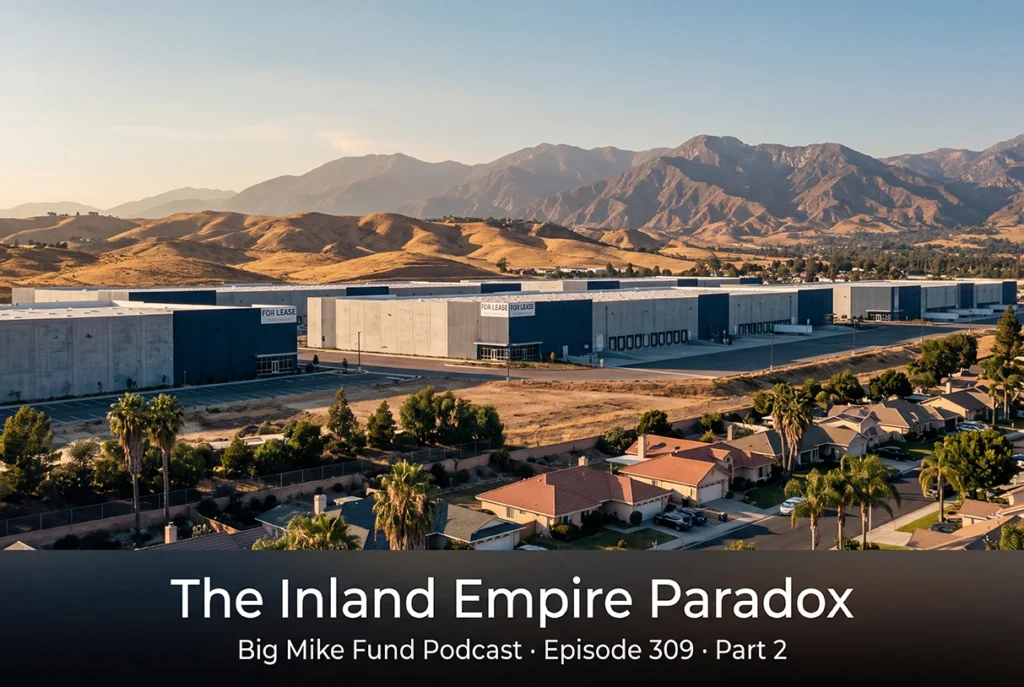
In Part 1, Chase Macleod explained why Dallas-Fort Worth is short on the biggest warehouses. Southern California’s Inland Empire industrial market is a different animal. Vacancy is higher, rents are inconsistent, and tenants hold more leverage than they have in years. Yet Chase still calls it one of the most dynamic logistics markets in the world.
How can both be true? It depends on which side of the deal you’re on.
For tenants: the best negotiating window in years
“If you’re a CEO or a business owner that needs to lease a warehouse, you’ve never had a better opportunity,” Chase said. Free rent, concessions and tenant improvement allowances are all on the table. He’s even seeing landlords agree to let TI dollars go toward a tenant’s racking, which he says used to never happen.
The hard part is that the market is “painfully inconsistent.” Some buildings have sat vacant for two years. Others lease in two months at within 5 to 10% of the asking rent. Companies that signed leases in 2021 and 2022 may be paying well above today’s market, by Chase’s estimate as much as 150% to 200% of current rates.
His advice for navigating it:
- Start 12 months early. If there’s any chance you’ll keep your footprint, begin the process a year before your lease expires.
- Start with budget. Every business has a ceiling, whether they admit it or not. In California that’s a price per square foot per month the business can afford.
- Then geography. The old rule is that rent falls the farther you move from the Ports of Los Angeles and Long Beach. But drayage costs rise with distance, and some Inland Empire pockets now rent higher than areas to the west.
- Then building specs, especially clear height. Not every tenant needs a 40-foot-clear building.
The clear-height opportunity
Institutional owners like Blackstone, JP Morgan and Clarion prize tall buildings because they don’t want an asset that’s obsolete in five or ten years. Since warehouse rent is charged on footprint, not cubic volume, many tenants aim for 36-foot clear or higher to stack more pallets.
But Chase’s team recently closed a 500,000-square-foot lease in Ontario for a client that was fine with 30-foot clear. Most developers would call that close to obsolete at that size. For this client, budget and proximity to the Ontario airport mattered more. The lesson: tenants willing to go “in between” on clear height can get an institutional-quality building in a great location for less.
For investors: why new acquisitions are hard to pencil
Mike asked the direct question: is this a bad time to own? Chase split his answer in two.
For investors looking to buy now, the fundamentals are tough. Leasing velocity is slower. Rents are inconsistent and probably on the lower end. And investors compete against owner-users, businesses buying buildings for their own operations. According to Chase, owner-users routinely pay 15% to 35% more than an investor would, so investors are often 30% or more behind on price.
Today, nearly every investor wants the same thing: a sale-leaseback, or a building leased for four or five years at a reasonable coupon. On a sale-leaseback, Chase says investors typically want at least a 5.5% return on the leaseback rent. On a leased building, they’ll accept a lower cap rate but want a price per square foot that sits below replacement cost.
His recommendation is to find the floor: the price per square foot you’d still be happy with if the tenant went bankrupt tomorrow, or if a vacant lease-up took 12 months instead of six.
The other side: supply is protected
Here’s the twist. Chase pointed to AB 98, a recently passed California law that, as he described it, makes it close to impossible to build a large new warehouse within about 1,000 feet of residential. The catch is that the best remaining sites for speculative industrial development are often near housing.
Mike summarized it well: supply is protected. With new construction this constrained, Chase believes scarcity in the Inland Empire will only increase.
Why leasing in the Inland Empire industrial market feels slow
If supply is limited, why is leasing slower? Chase’s answer: uncertainty. He sees fewer companies leaving California outright than people assume. Instead, decisions are being delayed by lingering tariff uncertainty from April 2025 and difficulty moving capital out of China.
The actual numbers are better than the headlines. Chase described the first half of the year as relatively strong for 200,000 to 500,000-square-foot leases. It gets overshadowed by net absorption figures and new inventory. And here’s the irony: by his estimate, 35% to 50% of that leasing has come from overseas Asian third-party logistics (3PL) companies, the same companies most affected by the tariffs.
Watch 2027
One date to circle: Chase expects the largest wave of Inland Empire lease expirations to hit in 2027, as the record leasing from 2021 and 2022 rolls over. That will put more space back on the market and give tenants even more leverage.
In Part 3, Chase looks beyond California and Texas to the port markets drawing the next wave of demand, and makes the contrarian case for building bulk warehouses now.
Listen to the full conversation on Episode 309 of the Big Mike Fund Podcast.